Showing posts with label Question of the Week. Show all posts

Monday, March 23, 2015

Teachers' Favorite Engaging Lessons


In my Spanish classes, I love to use flip books to engage students in note taking, practice activities. By creating flip books, students have a complete resource to also use as a study guide for an assessment. Here's a recent blog post which explains more!
-Emilie 


While maybe not my favorite activity, one of my favorite ones that I've started doing this year is Visual Discovery. It involves having students analyze powerful or interesting images as a means of teaching culture and history (it's actually a technique used in Social Studies).


I do a game I call "Silla caliente" (Hot Seat) when I want to review vocabulary. I split the class into two teams. I make a presentation of all vocabulary without words, just a visual representation of each. I put two seats in front of a screen facing the opposite direction. Each team offers a contestant to play. A vocabulary word is posted after the contestants sit. They cannot see the word. The goal of the game is to get the person seated infront of the screen to say the vocabulary word
-Zachary Bissonnette

I love playing "Guess the Famous Person Using 20 Clues" with my students, then having them create their own clues for additional people and finally finishing by having them research other famous Hispanics/Francophones and doing presentations. Great combination of reading, writing, speaking, grammar, and culture - plus it's really fun! Also good for no prep sub plans.
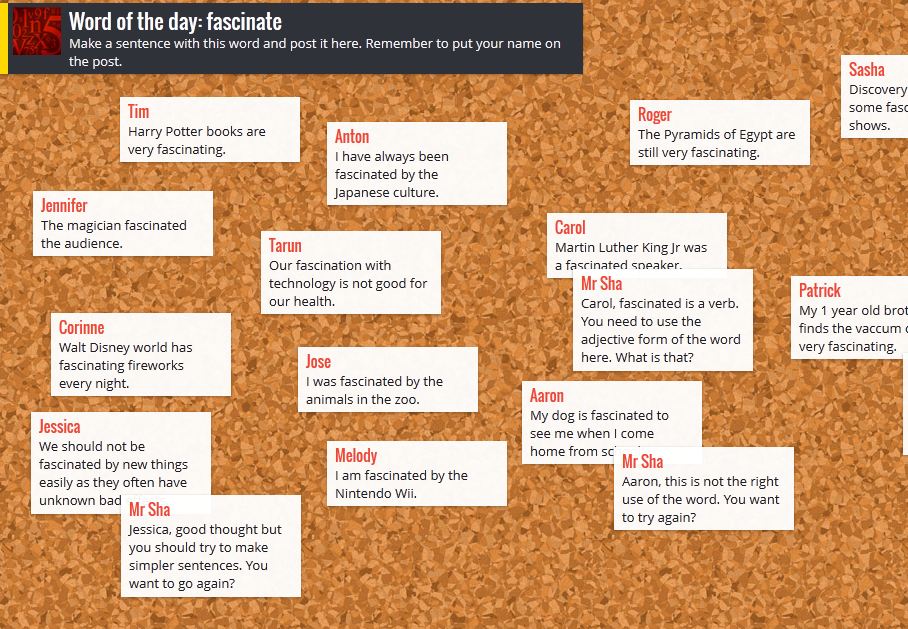
I just tried this for the first time a few days ago, and my students really responded. This could be used for any sort of writing you want your students to do... I was working on having my students write sentences using the imperfect progressive with an interrupted preterite action. Your students will need access to computers/tablets/mobile devices. Here is what I did....

1) I created a powerpoint with interesting images (mainly gifs, they love gifs!) to inspire them to write a sentence.... around 7 slides.
2) I created a open and editable padlet and shared with my students.
3) I projected 1 slide of the powerpoint, and students simultaneously wrote their descriptive sentences on the padlet.
4) After most of them were writing and didn't need the images anymore, I switched my projected screen to the padlet, and we looked at all of their sentences. As a class, we pointed out errors.... What is wrong in this particular sentence? How can we change it to be correct? I also pointed out exemplar sentences.

I asked the students after class if they enjoyed the activity and if they thought they got anything out of it, and they responded that they really liked seeing everyone's work all at once so they could see common errors.

If you would like to see my powerpoint, it is here: Be sure to download instead of viewing it though google drive so you can see all the gifs!


Using a webquest for clothing vocabulary is one of my favorites because it makes students discover the vocabulary on their own. Instead of teaching a set of vocab words, I give the students the words and they have to discover what the words mean by looking at an online clothing website. The students are very engage “shopping” and learning how to use context to discover meaning. The teacher can walk around the monitor but the lesson is student centered!

Tuesday, February 10, 2015

Leveled Readers for Second Language


I have typically only used leveled readers in the 4th and 5th years of language studies. In the 4th year we have read "El Abuelo ya no Duerme en el Armario" which is available from Scholastic Books. It has nice, manageable chapters so it is excellent for an introduction to reading longer narratives. In 5th year we have read Lazarillo de Tormes, Marianela (my personal favorite) and student additions of Don Quijote.

One of the keys to implementation is to vary the way in which the chapters are read (whole class, small group, partner, individual) and vary the activities (graphic organizers, alternative ending activities, etc). Reading longer books can be daunting for students and is very time consuming. Mixing things up will avoid that "Groundhog Day" feeling.


My absolute favorite to use with higher level Spanish students is "Cuentos con sazón". I stumbled upon this when looking for a reader for my Spanish 5 students. The novel starts off with a family reunion that turns into each relative telling a story about growing up in various Hispanic cultures. It combines culture, food, morals, and humor to create a great reader. My students read, discuss, and act out the book. For their end of year project, they write their own chapter including a moral, a famous festival in the country of their choice, and of course, advanced grammar. If anyone is interested, I could put together a packet of resources for it. My students loved it! Email me at worldlanguagecafe@gmail.com if you're interested.
For French, I love Le Petit Nico and the readings in Trésor du temps (history based French text).


Monday, February 2, 2015

Grades

This week's question of the week is about grades. A user asked "How do you weight your grades? Do you assign a certain percentage of the grade towards homework, classwork, tests, etc?"
Here are how some Foreign Language teacher's answered:

Monday, January 26, 2015

Activities for Language Club

If you are a sponsor for your school's Language Club or Culture Club, or are thinking about starting a Spanish Club, French Club, German Club we'd like to offer some fun activities that you can do with your students. 

Monday, January 19, 2015

Promoting Reading in WL Classroom

This week's Question of the Week asks how teachers promote reading in the target language. Here's what our teachers had to say:

Spanish Sundries:
I like to encourage students to read in the target language by engaging them in reading activities that are appropriate to their level AND interesting. I have had a lot of success using infographics as reading activities for all levels of student. You can read more about using infographics in the classroom in this blog article.

Get reading activities (novice, novice-high, and intermediate available) to accompany infographics here.


The World Language Cafe:

Create a Reading Library:
At all the schools where I have taught, I have started a reading library either in my classroom or on a rolling cart to be shared within the department. You can purchase the books through various sites (borders.com, amazon.com, scholastic – great collection of books in Spanish). Sometimes, you can get your department or school to pay for the books and the cart. We shared a cart within our World Language Department and had a clipboard to sign the cart out for class periods. I applied for grants through the school’s education foundation to purchase the books. We use the books in a variety of ways:

1. After tests and quizzes, students had the option to start their homework (for my class) or to have free reading time. The students like reading the books because many are the same books that they read when they were kids. This is also a great way to challenge your top students.

2. Read books out loud to practice pronunciation. Student pronunciation improves dramatically when they read aloud.

3. For extra credit, have students take a book home and make a glossary for all the difficult words in the book. They should organize the words alphabetically, type and double space them in a small font, and hand them in for you to check. Correct them, and have the students resubmit the final copies. Tape them in the back of the book so that students can search for the meanings of difficult words in the glossary.

4. Have advanced students read books to younger students. They can practice reading the book out loud using animated voices, use props to help explain the meaning of the story, and teach students gestures for common words in the book. When the younger students hear the common words, they can do the gestures as well. Have the advanced students practice a few times before they read.

This Reading Library is one of the ideas from my 50 Games and Activities to Spice Up Your Classroom product (also available in French or World Language).


Señora Speedy:
We've been writing collaborative class books in kindergarten and are getting ready to write another one in first grade. Kids are writing, reading, and connecting with the target language. After we read the finished product in class I send it back with them to their homeroom where they can add it to their class library and read it again and again. 


SpanishPlans:
I use student choice to allow my students to explore the topics that interest then. Many of the students choose sports and read articles on espndeportes or they can choose to read about celebrity gossip, fashion, animals, movies, or anything else that interests them. Read more in my blog post.

Anonymous:
I have my Spanish 3 students read the daily news from online newspapers & networks. Dos Mundos (bilingual) newspaper is great!

Friday, October 3, 2014

Assessing Speaking with Technology

In a foreign language classroom such as Spanish, German, or French, giving feedback to students on their speaking skills is an important component. There are many tools that we can use to help assess students. So, our question this week focuses on what technology teachers use to assess speaking.


Monday, September 1, 2014

Question of the Week: Sub Plans Part 1

We don't want to have our subs saying this, especially since many schools has a no-movie policy in place. But fear not, our talented teachers have some great activities and suggestions for you to implement when you need an emergency lesson plan in Spanish, French,  or any other language class.


Answer from  Island Teacher Blog
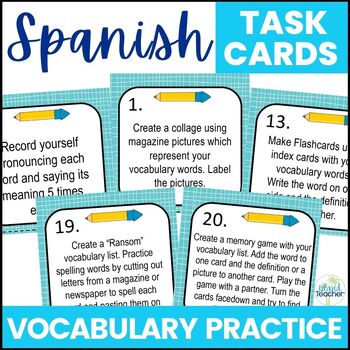
I love to leave general activities which can be adapted to whatever unit we are studying. This is one of the reasons why I created vocabulary task cards. These cards give students various task options
which can be used with any vocabulary unit. I give students a choice in which tasks to complete and require a specific amount to be handed in either at the end of the class period or when I return. This is a great way for students to still be productive in reviewing current class material without having a "wasted" day because of me being absent.

Answer from Caroline Marion I-Speak-Your-Language 
Many schools require sub plan folders ready to go on your desk when school begins. However, I have been caught without sub plans ready and have been able to e-mail in my lesson plans from home thanks to the internet.
In foreign language classes, we often face the problem of a sub who doesn’t speak the target language, making sub plans a difficult task. One idea is to have a great video or DVD that can be shown to the class. This should also include a set of questions over the video so students are accountable for something.
I have three products that can be used for sub plans.

This is a trivia game in English in which all answers are names of countries where Spanish is one of the official languages. It is my best seller.
Here is a reading in English about the Fiesta de San Fermin. Includes a trivia game and a mini-poster which can be cut up into a jigsaw puzzle. This product takes a little prep time to get it ready for the sub.
Here is a French reading, “Mon Oncle Jules” by Guy de Maupassant. It has been revised and simplified for French II students.


Answer from SpanishPlans
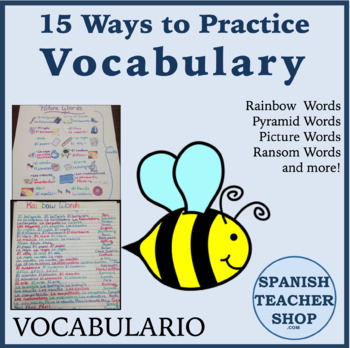
I try to have a few activities ready to go depending on where my students are in a unit. For example, if we are at the beginning of a unit, I will give students class time to practice their vocabulary with my Vocabulary Practice assignment where students can choose various activities worth varying points to remember their vocab. Kids love this activity and it keeps them busy in class and also helps tremendously with memorizing vocabulary.


Answer from Spanish Sundries 
For me, there are 3 components that a sub plan needs to have for things to go smoothly while I am gone;
1. It must not require the sub to speak Spanish (since they rarely do)
2. It must be tied to what we are learning or have learned (kids can spot busy work a mile away)
3. It must be VERY engaging...dare I say FUN so that those not so self-motivated actually want to do the assignment

These are some of my favorite activities to leave for emergency lesson plans as they meet all 3 criteria and then some:
Infographic Reading Activities
Spanish Logic Puzzles
Spanish Cartoon Listening Activities
With plans like these I don't have to feel guilty because I know my students learned something, but I also don't have to follow up on behavior issues when I get back.


I created a really fun PowerPoint that can be used for French and Spanish sub plans for levels II and up to AP. Students guess famous Americans and Hispanics based on 20 clues in the target language. The game reviews Spanish adjectives, professions, age, tener, ser, estar, etc., while learning interesting facts about famous people. These sub plans can be used for one day and then used again a few months later or can be used for three- five days of sub plans in a row.

There are descriptions and pictures of 27 people in total (15 Americans and 12 Hispanics). Some famous Hispanics are included, but not too many so that students can then research others and create their own clues. More advanced students can delve deeper into learning about other noteworthy Hispanics through a resume writing project. They will write resumes for the famous people, create an audio/visual, and then present to the class. The instructions and grading rubric for this project are included.

Check back for new posts with more sub activities! 


Tuesday, August 19, 2014

Question of the Week August 18 Changes


While summer is a great time to rest and spend time with family, it is also a time of planning for teachers. Many teachers use their vacation to reflect on the past year and begin planning for the upcoming school year. Our teachers at Language Teacher Cafe have reflected and have come up with the following changes they plan to implement in their classes this year:


Thursday, May 22, 2014

Thursday, May 15, 2014

Question of the Week: Absences


This week's question, submitted by a guest, was: How do you use your classtime effectively when you have multiple students missing class due to a school function? Whether it be a field trip, a sporting event, a club meeting, or other school responsibility that forces a group of students to miss class, we still must continue teaching to the students who are present.

Our teachers had some great enrichment activities for the students who were in class to further their language skills, while not creating something that the missing students would have to make up. Here's what our teachers had to say:

Thursday, May 1, 2014

Question of the Week 5/1


Thursdays on Language Teachers' Café we bring you a guest blog post, a feature on a WL teacher, hot topics in World Language, or, this week, a Question of the Week answered by our panel of teachers.
This week, the question was "How has being able to communicate in another language impacted your life"? I think the answers to these question clearly show how valuable learning and knowing another foreign language can be. Share this answers with your students and let them know the opportunities that await them!


Thursday, April 24, 2014

Question of the Week 2


Thursdays on Language Teachers' Café we bring you a guest blog post, a feature on a WL teacher, hot topics in World Language, or, this week, a Question of the Week answered by our panel of teachers.

This week's questions was:
What is your favorite website for students to practice the language inside or out of class?


  • Duolingo.com - a free language-learning text translation website and app.
  • Quizlet.com - Online flashcards
  • StudySpanish.com Spanish grammar, vocab, verbs
  • Zambombazo - "Una variada oferta de actividades divertidas basadas en obras culturales (canciones, tiras cómicas, carteles de cine, publicidad, arte, etc.) en las que se pretende aprender por descubrimiento sobre el idioma español y las culturas del mundo hispanohablante."
  • Digital Dialects.com - A variety of topics for French language learners using iPads.
  • Spanish Language and Culture with Barbara Kuczun Nelson - You may remember this site titled Spanish Grammar Exercises, it has lots of great practice.
  • Conjuguemos.com - practicing conjugations
  • Lyricstraining.com - "easy and fun way to learn and improve your foreign languages skills, through the music videos and the lyrics of your favorite songs"

Websites submitted by:
@nellyanhuh
@MaestraMc
@mcastroholland
@SpanishPlans 
German Sektor
World Language Café
Spanish Sundries
Madame H 

What do you do in your classroom? Share with us in the comments below!

Thursday, April 17, 2014

Question of the Week


Thursdays on Language Teachers' Café we bring you a guest blog post, a feature on a WL teacher, hot topics in World Language, or, this week, a Question of the Week answered by our panel of teachers.

This week's questions was:
What is your favorite activity to use when you have 5 extra minutes at the end of a class?

Spanish Sundries says:
  1. Spanish-speaking Country Trivia! I develop a bank of questions and ask a few at the end of class.
  2. Four Square: Students fold a piece of paper into 4 boxes and write a vocabulary word in each. I choose 4 words at random and the student who matches the most wins.
  3. Yo espío - I choose an item and students ask yes or no questions in Spanish to guess what it is.
@nellyanhug says:
One student takes a card with the picture of an object, person, place, animal, etc.
Option 1- A student describes the picture in the target language using circumlocution. Students who guesses correctly is the next one to talk.
Option 2- One Student looks at a picture and the rest of the class tries to guess what it is by asking questions (can be any kind of questions or just yes/no questions). Student who guesses is next. 


German Sektor says:
Lingo is a great end of class game - pick any five letter word in the target language and have students try to guess what it is. They have five chances to guess correctly. For each of their guesses, you circle letters that are in the word but not the correct spot AND you put boxes around letters that are in the correct spot. Works with any language! For more detail and examples: check out her post!

SpanishPlans says:
If I have just a few minutes I'll pull up a music video on Youtube. Sometimes I'll pull up an official video, but a lot of the time I will pull up a lyric video. Kids not only get to hear a catchy tune, but they get to hear and see words. If a vocabulary word or phrase comes up, I can ask the class if they remember what it means. A lot of artists, such as Jesse & Joy, now post their own lyric videos.

@MaestraMc says:
Serpiente: each student says a word in a serpentine fashion around the seating arrangement. The next word must begin with the last letter of the previous word. Extra time? Make it go back again so each student is up to bat twice! No repeats. This helps students be quick on their feet with recall.

Rachel Frenkil @frenkilstein says:
If I'm trying to kill time, I'll pull up a video in Spanish about the country we're studying, like a tourist video or short film. Though I don't assess, it's time where the students can listen to an authentic accent, learn something cultural and work on their listening comprehension (i.e., it's okay if you don't understand every word).

Julie from Open Wide the World says:
"Qui suis-je?" or "¿Quién soy?" is a fun, quick filler game. One student thinks of a famous person (or selects a person from a stack of images you may have on hand, cut from magazines, etc). Classmates ask questions to determine who he/she is. Questions can be yes/no, or open ended, depending on the proficiency level of the class. Alternatively, the student can give clues about who he/she is. This is always fun. Students barely realize it's work!

Madame H shares:
I like to play Improv Monologues or Improv Dialogues with students. I will offer a Baggie or cup with various ideas in it, set a timer, and make the students use the target language until the buzzer goes off. This activity usually makes the entire class laugh. Especially when someone chooses the option to imitate the teacher! It's definitely fun!

Other ideas shared with us:
  • Question & answer chain with ball toss.
  • "Around the World": Have 2 students stand up and ask them a question or for a translation. The first to answer correct wins and moves on. The loser sits down. As the winner works his/her way around the classroom, they end up sitting in whatever desk they lost to. The person who goes the farthest wins.
What do you do in your classroom? Share with us in the comments below!