Wednesday, April 8, 2015

World Language Featured Teacher: Caroline Marion


This week's featured seller is Caroline Marion, of I Speak Your Language. You'' definitely want to visit Caroline's TeachersPayTeachers store.

Teaching History:  
My 20+ years of teaching included teaching high school French/Spanish, and K-12 ESL. These jobs took me to Nebraska, Texas, Iowa, and Minnesota. I am now retired from teaching but continue posting some of my favorite lesson plans on the Teachers Pay Teachers’ website.

Favorite Thing about Teaching Languages:
I enjoyed watching my students take “center stage” acting out sentences in the target language in a game of charades or doing little skits, such as ordering a meal in a restaurant or introducing oneself to a fellow traveler on a bus.

Favorite Lesson:
When teaching the familiar you command form in Spanish, I taught students a short musical phrase to help them remember the rule.

The phrase “Ay, ay, ay, ay, canta, no llores” (from "Cielito Lindo") helped my Spanish students remember that the affirmative “tú” command drops the “s” but the negative command retains the “s” and changes the ending from “–as” to“-es” on “–ar ending verbs”.

When we were correcting their worksheets, I had students read their answers and the class would remain silent if the answer was correct. If they heard a mistake, the class would sing the phrase, “Ay, ay, ay, ay, canta, no llores” (Oh dear, sing don’t cry.) The student in error would then try to correct the mistake. This kept the attention of the class and brought smiles to students’ faces even if they made mistakes. When test time came around, I told students they could hum the melody to remember the rule.


One Tip to WL Teachers:
Use visuals, actions, and music to keep your language presentations interesting and memorable.

Free Product:
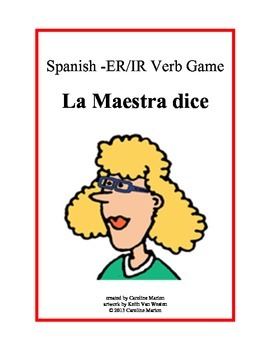
Spanish –ER/IR Verb Game – La Maestra Dice

Challenge students to repeat sentences filling in the “blank” as they try to “match” the teacher response.

Examples: Mi padre bebe una taza de ____________. (a drink)
¡Qué lástima! No comprendo mi tarea de _____________. (a subject)


Featured Product:French End of Year Game – Parlez ou Pantomime
This fast-paced game makes a fun year end review for students who have just one minute to give oral clues or gestures, hoping their team can guess the six words in a category (verbs, clothing, foods, animals, professions, places, feelings, and more).

1st – 2nd yr. French, grades 6th-10th 


Wednesday, April 1, 2015

Featured WL Teacher of the Week: Sherry Schermerhorn

This week's featured seller is Sherry Schermerhorn of The World Language Cafe. You can visit Sherry's TeachersPayTeachers store and her blog The World Language Cafe.

Teaching History:
Taught high school French and Spanish for 9 years before deciding to stay home when I had kids. Currently, I'm raising my kids bilingually (even though I'm not a native speaker - they're definitely my biggest teaching challenge) and I teach a Spanish class in my home for 4-6 year olds.

Favorite Thing about Teaching Languages:
I love it when students get lost in the moment and forget that they're speaking another language because they're having so much fun. I always pride myself on having a somewhat noisy classroom because that means that my students are thoroughly engaged in an activity.

Favorite Lesson:
Famous Hispanics: I created a 20 clue guessing game to teach my students about famous Hispanics. It's a PowerPoint that shows the clues one by one and then a picture of the person at the end. After each clue, they write down a guess of who it is. At the end, the person who got it right first, gets to be the person who clicks and reads the next set of clues. I start out with famous Americans and then move on to famous Hispanics. Afterwards, students make their own set of 20 clues as a homework assignment. To top it all off, we finish by researching additional famous Hispanics and doing mini-presentations about them to the class.

I love this project because it combines, reading, writing, listening, speaking, and culture all in one and the students have a blast. I'm always looking to "spice up my classroom" and this lesson does just that.


One Tip to Language Teachers:When you are planning your lessons, think about how people learn languages naturally when they are kids. We don't learn from doing grammar lessons in a book or conjugating verbs. We learn by using the language every day and hearing expressions repeatedly. Whenever I meet people who say that they tried to learn Spanish in high school and are really bad at languages, I always say, "Well, that's funny because you speak English pretty well!" How we teach is so important. Immersion is a must! Even if your classroom is not an immersion classroom now, you can change that, even mid-year.

Spend every Monday talking about what your students did over the weekend. Have your students leave 3-4 blank pages in their notebook for weekend news expressions. Write common difficult expressions on the board and have them write them down in their notebooks. That way, each week, they can build on what they have learned. Have other students ask follow up questions. Ex. If a student says, "I went to a soccer game", other students can ask: Where was the game? When was the game? Who won the game? Did you go to the game with anyone else? Did you eat anything at the game? Who scored a goal? etc.

Allow time for these discussions to get longer each week as the students get better at speaking. After all, this is the type of language that they will most need to be able to communicate. By the end of the year in my class, we spend almost all of Monday just talking, but all in the target language. Through these discussions, present any grammar that they need, but in the simplest manner possible (as you would to a 2-4 year old) - just give the expression that's needed.


Free Product:

Mexican Flag Spanish Flag Photos and Interesting Facts
When I was teaching about the Hispanic countries and their flags, I realized that flags just aren't enough to teach
students about the countries. Wouldn't it be more fun to see pictures of the people, sites, foods, and festivals? So I began creating a country bundle that includes 6-8 colorful photos, flags, maps, and interesting facts for each of the 21 Spanish speaking countries. I added songs, nationality practice, word searches, and more so that I could teach about 1 different Spanish speaking country per week in my classroom. Instant culture!


Featured Product:


Spanish Speaking Countries Flags, Photos, Maps, PPT for 21 Hispanic Countries


You can also print the photos on cardstock, laminate them and use them as classroom decorations. A great way to inspire your students to learn the language so they can visit all these amazing places.

Wednesday, March 25, 2015

German Teacher of the Week: Frau Leonard

This week's featured seller is Ashley Leonard of Frau Leonard. You can visit Ashley's TeachersPayTeachers store and her blog The German Sektor.

Teaching History:
I've been teaching in Maryland for the past seven years. I've taught World Language at the high school level in Howard County. Because I can teach German, Latin and French, I've had a lot of different schedules throughout the years - everything from the lower levels to AP.

Favorite Thing about Teaching German:
Aside from my own personal love for grammar, I like sharing the culture with students - seeing something spark their interest that then ignites for a love of the language.

Favorite Lesson:
I'm partial to anything where I get to talk about history. Whether it's breaking out the Nibelungenlied (modified for students, of course) or talking about the Roman emperors, it's something I get excited about. In general I think anything you get excited about will get your kids excited too.

One Tip to German Teachers:Save everything! Even if your lesson didn't go so well, save it for next year. Maybe leave a post-it note on it about what worked (or didn't work), how long it took, anything. Next year you'll be glad. With enough time to think about it, I've been able to turn some rather dull lessons or just complete flops into something great.

Free Product:

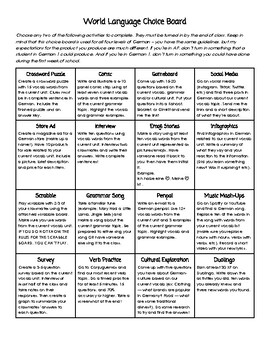
Sub Plans Choice Board

This is a Choice Board that I use as my Emergency Sub Plans. It requires little prep on the teacher's part - just make a bunch of copies of the choice board and activities. It's generic enough that you can use it with pretty much any unit you're covering and for any language (which is why it works so well as emergency plans!).


Featured Product:
UNO Cards Template
This UNO Template lets teachers create UNO cards for students to practice a variety of topics. The easiest and

most obvious use for language teachers would be verb conjugation - put a subject in the corner of each card and an infinitive in the center. As students lay down their cards, they need to conjugate the verb for whatever subject is on the card. Great because one set works for all tenses, making it easy to re-use the same cards year-to-year and level-to-level.

Monday, March 23, 2015

Teachers' Favorite Engaging Lessons


In my Spanish classes, I love to use flip books to engage students in note taking, practice activities. By creating flip books, students have a complete resource to also use as a study guide for an assessment. Here's a recent blog post which explains more!
-Emilie 


While maybe not my favorite activity, one of my favorite ones that I've started doing this year is Visual Discovery. It involves having students analyze powerful or interesting images as a means of teaching culture and history (it's actually a technique used in Social Studies).


I do a game I call "Silla caliente" (Hot Seat) when I want to review vocabulary. I split the class into two teams. I make a presentation of all vocabulary without words, just a visual representation of each. I put two seats in front of a screen facing the opposite direction. Each team offers a contestant to play. A vocabulary word is posted after the contestants sit. They cannot see the word. The goal of the game is to get the person seated infront of the screen to say the vocabulary word
-Zachary Bissonnette

I love playing "Guess the Famous Person Using 20 Clues" with my students, then having them create their own clues for additional people and finally finishing by having them research other famous Hispanics/Francophones and doing presentations. Great combination of reading, writing, speaking, grammar, and culture - plus it's really fun! Also good for no prep sub plans.

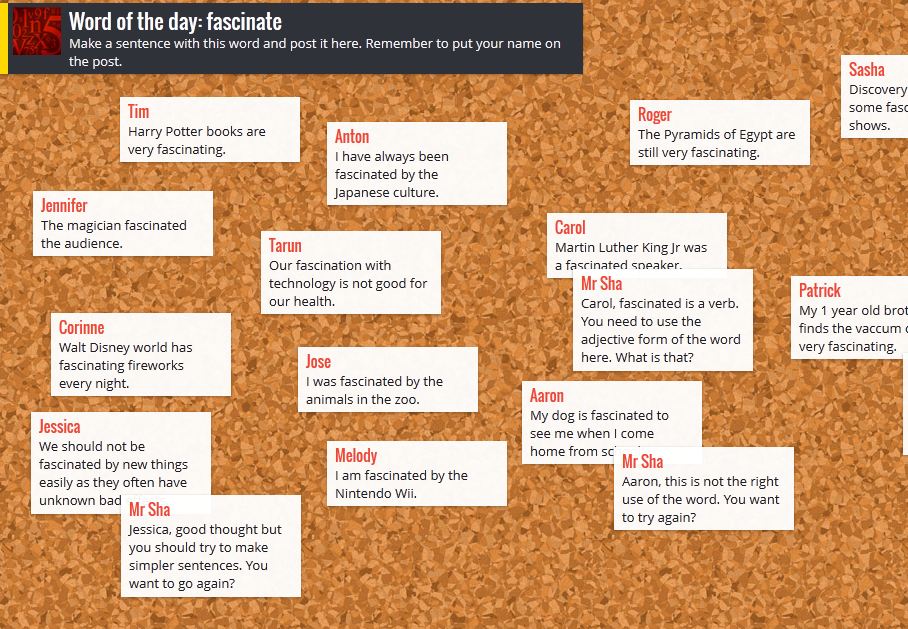
I just tried this for the first time a few days ago, and my students really responded. This could be used for any sort of writing you want your students to do... I was working on having my students write sentences using the imperfect progressive with an interrupted preterite action. Your students will need access to computers/tablets/mobile devices. Here is what I did....

1) I created a powerpoint with interesting images (mainly gifs, they love gifs!) to inspire them to write a sentence.... around 7 slides.
2) I created a open and editable padlet and shared with my students.
3) I projected 1 slide of the powerpoint, and students simultaneously wrote their descriptive sentences on the padlet.
4) After most of them were writing and didn't need the images anymore, I switched my projected screen to the padlet, and we looked at all of their sentences. As a class, we pointed out errors.... What is wrong in this particular sentence? How can we change it to be correct? I also pointed out exemplar sentences.

I asked the students after class if they enjoyed the activity and if they thought they got anything out of it, and they responded that they really liked seeing everyone's work all at once so they could see common errors.

If you would like to see my powerpoint, it is here: Be sure to download instead of viewing it though google drive so you can see all the gifs!


Using a webquest for clothing vocabulary is one of my favorites because it makes students discover the vocabulary on their own. Instead of teaching a set of vocab words, I give the students the words and they have to discover what the words mean by looking at an online clothing website. The students are very engage “shopping” and learning how to use context to discover meaning. The teacher can walk around the monitor but the lesson is student centered!

Wednesday, March 18, 2015

Teacher of the Week: Yona Smith

This week's featured seller is Yona Smith of Spanish Resource Shop. You can visit Yona's TeachersPayTeachers store and her blog Spanish Resource Shop.

Teaching History:
I taught high school Spanish level 1 and 2 for 16 years before moving on to teach SPN101 and SPN102 at the college level where I currently work.

Favorite Thing about Teaching Spanish:
My favorite thing about language teaching is watching students go from having absolutely no knowledge in the language to having a mini conversation or writing a composition. It is such a joy to see their pride of accomplishment and sometimes even surprise at their abilities!

Favorite Lesson:
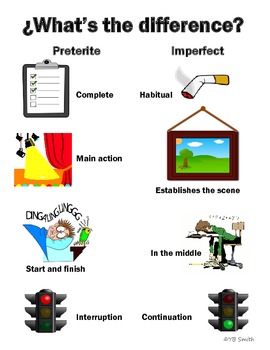
I used to hate teaching the preterite and imperfect until I developed some visual resources that really help to re-enforce the differences between the two. Now I actually look forward to teaching these two tenses because the students understand it so much better! I introduce the overall idea of the two tenses using an animated presentation that I created showing the difference: preterite is like a movie and each action leads to the next whereas the imperfect is like a photograph and the verbs describe the scene. I also developed picture notes listing the contrasting reasons side by side such as preterite - completed action vs. imperfect - ongoing action. I find that pictures and visuals really make all the difference in the world!

One Tip to Spanish Teachers:
I am a supporter and proponent of immersion classes and keeping as much as you can in the target language, but sometimes we need to let the English help! A perfect example of this is when you are contrasting the preterite and imperfect tenses. I use a 'test' to practice with my students in English. I tell them that if they are having a hard time deciding on which tense to use that they should 'test' it. For example: I went to the store every day looks like the preterite on the surface level (went); however it is really imperfect! Why? It failed the test! Here's the test: Can you substitute was _____ing, would _____, or used to ______???? Yes! You could say, I would go/I used to go to the store every day! That tells you that it is the imperfect tense in this sentence! This works great when you are having your students translate as well as when they are trying to write on their own!


Free Product:


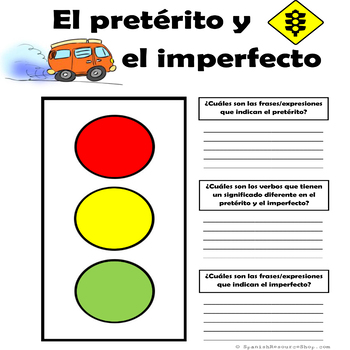
Spanish Preterite and Imperfect Traffic Light Phrase Indicator


 Use this Traffic Light to have your students keep track of key words and phrases for each of these tenses!

Green indicates GO - they write words and phrases that indicate ongoing actions in the imperfect... such as 'todos los días', etc.
Red indicates STOP - they write words and phrases that indicate an interruption in the preterite.... such as 'de repente', etc.
Yellow is for CAUTION - they write the verbs that can cause problems because they can change meaning between the preterite and imperfect!

This is a great visual organizer that once completed can be used as a reference sheet for your students.

Includes a colored traffic light and a black and white traffic light, that your students can color themselves.

Featured Product:


Spanish Preterite and Imperfect Difference PICTURE Notes

This is an easy way to keep the preterite and imperfect straight! Let the students SEE the difference with pictures!
This is a concise study tool for students listing all of the major reasons for using the preterite tense and the opposite reasons for using the imperfect tense. You won't believe you ever taught these tenses without it!