Friday, October 31, 2014

Task Cards in the World Language Classroom


Task cards are quickly becoming a new buzz word in Education.  If you've been to a conference lately odds are you've probably heard the term.  Task cards are a great way to break up the monotony of a typical class period.  They are also a phenomenal tool to help with differentiating instruction:  provide struggling students with lower level tasks while those who have grasped the concept can work on tasks that are more complicated.  How can these task cards be incorporated into the World Language classroom?  Keep reading to see 5 ways task cards can be used in action:

1.  Independent Work- Have your students work individually by distributing a set of task cards and a student answer sheet.  Students work quietly at their desks to complete the questions provided.  The teacher can check the questions with the answer key upon completion.

2.  Homework- Copy and laminate several sets of the task cards for multiple semesters of use.  Distribute several cards for students and have them answer them in their notebooks for homework.  This can be an ongoing homework assignment by shuffling the cards and redistributing them over a period of several days.

3.  Cooperative Learning Activity- Assign students to groups of 3-4.  Distribute one student answer sheet and a bag of task cards.  Students work together to complete the questions.  Add some competition to reward the first three groups who finish first.

4.  Scavenger Hunt- Tape the task cards around the room and have students work their way through the questions by moving around.  Be sure to provide them with a student answer sheet so that they can keep track of their responses and so that it is easier for the teacher to grade.

5.  Scoot- Tape task cards to desks around the room.  Set a timer for 30 seconds.  Students move from desk to desk when the buzzer sounds to answer the questions on the task cards and record them on their student answer sheets.

Task Card Round Up
Here are some ready made task card sets to try out in your classroom!

Italian
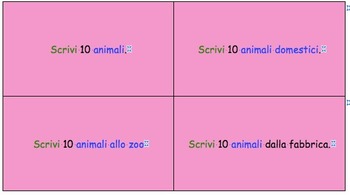


  Task Cards in Italian   

French        

Tuesday, October 14, 2014

5 Ways to Celebrate Día de los Muertos

Día de los Muertos is coming soon! Day of the Dead is celebrated annually on November 1-2. I know that I am always looking for fresh ideas to help students understand elements of this holiday and to steer them away from thinking that the celebration is just "Mexico's Halloween". Here are 5 ideas for infusing this holiday into your classroom!

1. Share an INFOGRAPHIC: The infrographic on this website is a great visual and gives a very basic intro to how and why the holiday is celebrated. I also like that students can see where the holiday is also celebrated in the US. Review the infographic as a class or have students write down their top 3 most interesting facts which they learned from the graphic.

2. Make PAPEL PICADO: This is a great YouTube tutorial that I used last year, and plan to use again this year. It includes a link in the description to download free templates for making your own papel picado. It turned out great and served as awesome addition to classroom decor! 


3. Watch the making of SUGAR SKULLS: I recently came across this video clip which explains the process of making calaveras de azúcar. I found it super interesting and I'm looking forward to sharing this clip with my students to spark some discussion about the tradition.  Watch the video by clicking here.


4. Explore the elements of OFRENDAS by reading in the target language: Don't you love Pinterest? I can always find some great ideas on there. These graphics detail various elements found on ofrendas and their significance. Better yet, this is all explained in Spanish. I plan to save these these images and add them to PowerPoint slides in order to project them in class. I will then have students work in pairs or small groups to try to identify different elements. I'll have students in lower levels use their dictionaries to identify key words. Here are the links to the images on one of my Pinterest boards:

5. Need some ready to go ideas? I have created 2 resources that are ready to print and use in your classroom. The first is a Día de los Muertos Poster Set. Get ready for the celebration by adding these to the your classroom walls or bulletin board to spark student interest. I've also added a Día de los Muertos interactive vocabulary flip book.. Students will create a flip book of images and definitions in order to better understand important key words associated with the holiday! 


Hope you enjoy celebrating in your classroom!
Emilie


This post was written by Emilie from Island Teacher.  

Friday, October 10, 2014

4 Tips for Beginning World Language Teachers


I am a retired teacher with a background in teaching French, Spanish and ESL. Here are a few tips for you new teachers entering the challenging field of teaching.
1.  Have students choose a name in the target language. Students really like the chance to choose their own name. (Hold off on this until the second or third week of school to be sure you know their given names.)
2.  Don’t forget to look around your school for foreign language resources right under your nose.  ESL students, foreign exchange students, and immigrant students might enjoy visiting your class and sharing their culture. Make it one of your goals to teach an understanding and appreciation of other cultures.
3.  Students need a lot of oral drill to develop speaking skills.  It’s hard to keep those drills interesting.  Two drills I often relied upon were surveys and a game called “The Teacher Says” where students have to repeat grammatically correct sentences and fill in the blank with a logical word trying to “match” the teacher.  Below are a couple links to free products.


4.  Another thing to do to keep your class interesting is to target multiple intelligences.  Use music, actions and visuals to liven up presentations and enhance memory.  Here is one paid product that uses visuals to drill making questions in French.

Best wishes for a great school year!

This post was written by Carolina Marion.  Visit her store by clicking here! 

Caroline Marion 

Wednesday, October 8, 2014

Classroom Decoration for Foreign Language Classes


Classroom Décor
 
Spice up your classroom walls with these posters and decorations for your Spanish and French classrooms.
 
Free
Spanish Subjunctive WEIRDO Poster
By Spanish Resource Shop
Paid:

by SpanishPlans 


by SpanishPlans
By The World Language Café

Friday, October 3, 2014

Assessing Speaking with Technology

In a foreign language classroom such as Spanish, German, or French, giving feedback to students on their speaking skills is an important component. There are many tools that we can use to help assess students. So, our question this week focuses on what technology teachers use to assess speaking.


Wednesday, October 1, 2014

Hispanic Heritage Month

Hispanic Heritage Month

For all you Spanish teachers out there, Oct. 15th-Nov. 15th is Hispanic Heritage Month.  Here are 10 fun, classroom activities to teach your students about the 21 Hispanic countries and famous Hispanics.  

1.  Research Project - Have your students research famous Hispanics and report back to the class using a 5 slide PowerPoint presentation.  

    Page 1: A cover slide with a picture of the person, his/her name, and birth date.
    Page 2: Why is this person famous?
    Page 3: Biographical information (family, country of origin, education)
    Page 4: Interesting facts about this person (ex. What challenges did he/she have to overcome?)
    Page 5: Some representation of the person's work (music, video clip, etc.)

2.  Map Study - Have your students learn all the Spanish speaking countries and where they are on a map OR for extra credit on a quiz, ask students to list Spanish speaking countries.

3.  Food Project - Assign each student or group of students a country.  Have them create the flag for that country, find out a few interesting facts about the country, and cook an authentic food from the country to share with the class.

4.  Daily Famous Hispanic - Every day or every few days, start class by teaching your students about a famous Hispanic.  (OR ask your students to do this and present to the class).

5.  Music - Find songs from different countries and play a song from each country at the beginning or end of class (or have the music playing while students are working).  You can ask students to find songs, too.  Younger students might like songs by José Luis Orozco.  

6.  Guest Speaker - Ask a native speaker to come to your class to talk about his/her country.  Props, accessories, and photos are welcome.

7.  Pen pals - Have your students write letters to students at a school in a Spanish speaking country.

8. Nationality Partners - To help your students learn the nationalities in Spanish, have them write 3-4 nationalities on a piece of tape or front page of their notebooks.  Then they pick a partner for each nationality and write it down.  Whenever you have activities in class, say which partners they'll be using.  Ex.  Parejas ecuatorianas  Ex. Parejas peruanas.  This ensures that they work with different people in class.  Every quarter, pick new nationalities and new partners.  Tell them that in a global economy, we need to learn to work with all different types of people.

9.  Read a Hispanic themed book and talk about cultural differences.  One of my favorites for advanced Spanish students is "Cuentos con sazón" by Lulu Delacre.  You can pick a chapter to read or read the whole thing.  Each chapter talks about a festival, celebration, or tradition from a different Hispanic country.  My students read the whole book and then write their own chapter for an end of year project.  Younger students might like "Arroz con frijoles y unos amables ratones"by Pam Muñoz Ryan.

10. Make a Hispanic craft with your students.  If you need ideas, you can check out my Pinterest page.  http://www.pinterest.com/worldlangcafe/hispanic-crafts/

 If all this sounds like a lot of work, I have created a few ready to use lesson plans for Hispanic Heritage Month.
Check out my "Famous Hispanics PowerPoint Game" and "Hispanic Flags, Interesting Facts, and Photos PowerPoint:  


Hope you have a wonderful month with your students.  
As always, happy teaching!


This post was written by Sherry Schermerhorn.  
Visit her store!

Monday, September 1, 2014

Question of the Week: Sub Plans Part 1

We don't want to have our subs saying this, especially since many schools has a no-movie policy in place. But fear not, our talented teachers have some great activities and suggestions for you to implement when you need an emergency lesson plan in Spanish, French,  or any other language class.


Answer from  Island Teacher Blog
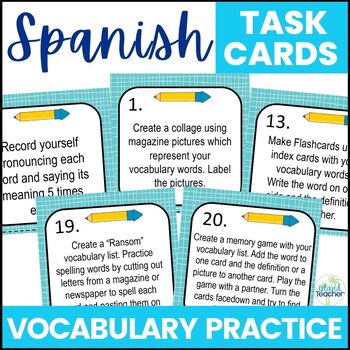
I love to leave general activities which can be adapted to whatever unit we are studying. This is one of the reasons why I created vocabulary task cards. These cards give students various task options
which can be used with any vocabulary unit. I give students a choice in which tasks to complete and require a specific amount to be handed in either at the end of the class period or when I return. This is a great way for students to still be productive in reviewing current class material without having a "wasted" day because of me being absent.

Answer from Caroline Marion I-Speak-Your-Language 
Many schools require sub plan folders ready to go on your desk when school begins. However, I have been caught without sub plans ready and have been able to e-mail in my lesson plans from home thanks to the internet.
In foreign language classes, we often face the problem of a sub who doesn’t speak the target language, making sub plans a difficult task. One idea is to have a great video or DVD that can be shown to the class. This should also include a set of questions over the video so students are accountable for something.
I have three products that can be used for sub plans.

This is a trivia game in English in which all answers are names of countries where Spanish is one of the official languages. It is my best seller.
Here is a reading in English about the Fiesta de San Fermin. Includes a trivia game and a mini-poster which can be cut up into a jigsaw puzzle. This product takes a little prep time to get it ready for the sub.
Here is a French reading, “Mon Oncle Jules” by Guy de Maupassant. It has been revised and simplified for French II students.


Answer from SpanishPlans
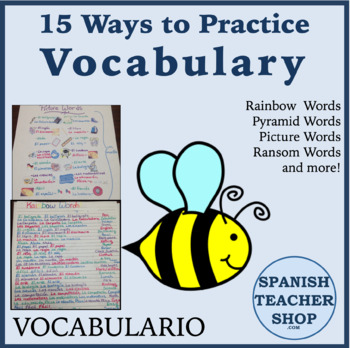
I try to have a few activities ready to go depending on where my students are in a unit. For example, if we are at the beginning of a unit, I will give students class time to practice their vocabulary with my Vocabulary Practice assignment where students can choose various activities worth varying points to remember their vocab. Kids love this activity and it keeps them busy in class and also helps tremendously with memorizing vocabulary.


Answer from Spanish Sundries 
For me, there are 3 components that a sub plan needs to have for things to go smoothly while I am gone;
1. It must not require the sub to speak Spanish (since they rarely do)
2. It must be tied to what we are learning or have learned (kids can spot busy work a mile away)
3. It must be VERY engaging...dare I say FUN so that those not so self-motivated actually want to do the assignment

These are some of my favorite activities to leave for emergency lesson plans as they meet all 3 criteria and then some:
Infographic Reading Activities
Spanish Logic Puzzles
Spanish Cartoon Listening Activities
With plans like these I don't have to feel guilty because I know my students learned something, but I also don't have to follow up on behavior issues when I get back.


I created a really fun PowerPoint that can be used for French and Spanish sub plans for levels II and up to AP. Students guess famous Americans and Hispanics based on 20 clues in the target language. The game reviews Spanish adjectives, professions, age, tener, ser, estar, etc., while learning interesting facts about famous people. These sub plans can be used for one day and then used again a few months later or can be used for three- five days of sub plans in a row.

There are descriptions and pictures of 27 people in total (15 Americans and 12 Hispanics). Some famous Hispanics are included, but not too many so that students can then research others and create their own clues. More advanced students can delve deeper into learning about other noteworthy Hispanics through a resume writing project. They will write resumes for the famous people, create an audio/visual, and then present to the class. The instructions and grading rubric for this project are included.

Check back for new posts with more sub activities!