Showing posts with label Any Language. Show all posts

Wednesday, May 11, 2022

Scaffolding the Interpersonal Mode


Have you noticed it's more difficult to encourage students to interact in the interpersonal mode in the world language classroom than it has been in the past?  If yes, you're not alone.  Common discussions circle around the fact that we were all isolated for so long so students now need to relearn how to converse in L1 before they can be expected to communicate in L2.  Others argue that students are always "plugged in" leaving less time for natural, face-to-face communication to occur.  Either way world language teachers are in a conundrum:  how do we encourage interpersonal communication in class?

One group of language educators started implementing what they refer to as Conversation Stations into their lessons to help with this situation.  What are they and how are they used in class?  Conversation Stations are a set of 10 different mini conversations based upon the same topic.  For example, the theme of School Life, Clothing, and Hobbies have been used with success following this model.  

The first step in creating the mini conversations after choosing the subject matter is to peruse authentic materials in the target language and highlight vocabulary that native speakers use in context.  What questions are common for this theme?  Keep these words and expressions in mind and then its time to let your own creativity come to life.  Now, it's time to develop 6 complete mini-conversations.  Anywhere from 3 to 4 exchanges is appropriate for learners.  Once the six complete conversations have been created, it's time to make 4 mini conversations with only one part of the conversation provided.  The portion provided could be either a question which would require a response from students or it could be the response which would then mean the students would have to think of a logical question eliciting the answer provided.  

The conversations are ready, now what?  In class students either choose a partner or are assigned to work with someone.  They move through the classroom to "stations" where only one conversation is seen.  Students are encouraged to work together to find the meaning of the interaction between the two roles first.  Then each student chooses a role and role plays by reading his/her part.  Students switch and repeat.  The repetition is important as it provides an opportunity for students to really grasp comprehension in context.  The learners work through stations 1-6 with the full mini conversations.  This provides them with a lot of input so that when they start with station 7 and only see half of the exchange, they can pull from what they've seen in stations 1-6 to think critically and solve the problem of how to respond in context to the statement or question provided.  Stations 8,9, and 10 further support problem solving and critical thinking.  After moving through all of the stations students are now at a point where they feel confident in creating their own conversations and the expectation of having them work in the interpersonal mode is more achievable.  

Here are links to several sets of conversations that can be used for various themes in Spanish and in French.  Simply click on the links provided.  

Spanish Conversation Stations Bundle

French Conversation Stations Bundle

How have you responded to the dilemma of encouraging student communication in the target language in your classroom?  


Sunday, September 16, 2018

Higher Order Thinking Skills in the WL Classroom


Higher Order Thinking Skills (HOTS) are activities in which learning requires augmented levels of cognitive processing.  On a Bloom's Taxonomy scale these activities would fall under the category of analysis, evaluation, or synthesis.  Chances are that if you're still in the classroom you've heard this terminology a lot.  How can we add these activities in the language classroom?

One way to incorporate HOTS is by providing students with more activities that require problem solving.  Think of conversations where students are only given half of the information and then must complete the missing parts logically to finish it.  This activity could be completed by providing students with blank spaces where the other half of the conversation would be found.  They could work individually to brainstorm possible responses and then after a specified amount of time students could partner up with each other.  Next, they would share their thoughts from their brainstorming session.  Then, students would decide who is Partner A and who is Partner B.  The teacher would provide Partner A with one half of the completed conversation and Partner B with the other half.  Students would take turns reading their role and filling in the page with what they hear from their partner.  Finally, students could create a Venn Diagram comparing and contrasting their initial ideas of the logical completion of the conversation with the full conversation they worked on with their partner.  As a follow up activity students could develop their own conversation on the same concepts for a class work or homework assignment.

Check out these ready to go activities for the French classroom:

L'École

 
Les Passe-Temps
La Jeunesse
Greetings and Salutations

How do you incorporate HOTS activities into your WL classroom?  We'd love to hear some other ideas!  Leave a comment below.


Monday, August 7, 2017

5 Tips for Using Bell-Ringers in the WL Classroom


The summer is winding down and several teachers are preparing to return to school in the United States in the next few days or weeks.  This post includes advice for getting the most out of the time you have with your students by implementing Bell-Ringers once class begins.

Research has shown over the years that Bell-Ringers are beneficial in many ways.  Namely, they help to set the tone for the students that it is time to focus and learn.  They also help students engage their prior knowledge from a previous class period.  And finally, they allow the teacher to complete daily administrative tasks that are required such as taking attendance and passing out papers.

Here are 5 tips to ponder for the upcoming school year:

1.  Have a Bell-Ringer already displayed on the white board or written on the board as students enter.  Be sure to always include an example response so students can see what is expected.  This will also eliminate students asking, "What are we supposed to do?"

2.  Be sure the Bell-Ringer takes 5 minutes or less to complete.  If the task is too complicated, students will be less likely to dive-in and respond to it.  Plus, it is important to devote other time to learning new concepts.

3.  Provide students with an answer sheet for the entire week or require them to keep their answers on one sheet of paper.  This will cut down on the amount of paper shuffling that you do during the year.  It will also encourage the students to be responsible for keeping up with their work.

4.  Take up the answer sheets on Friday or the last day that your class meets for the week.  Quickly look that the students attempted the answers and that they corrected any errors that they might have made.  This will also give you an extra opportunity to see who is struggling and needs more of your attention.  Add this assignment as a class work grade for class participation.

5.  Spice things up by playing your favorite target language music as students complete the Bell-Ringer.  Mix up the genre each day and be sure to write the artist's name on the board so students can listen to the music on their own time outside of class.  Have a rowdy class?  Play music with a slower rhythm to calm them down.  Have a class who is still asleep or drowsy?  Do the opposite and play tunes with some pep.

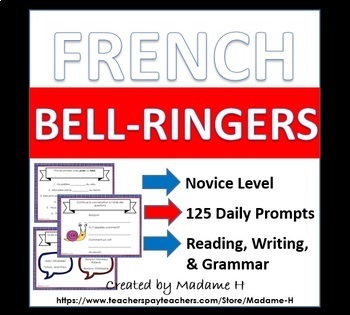
Here are some ready made Bell-Ringers to help save you some time and planning.


How do you use Bell-Ringers in your classes?

Saturday, July 30, 2016

Creating a classroom library in world language class

Want to get your students excited about reading in the target language?  

It’s much easier and cheaper than you’d think to create a reading library in your World Language classroom.  By creating a library of children’s books in the target language,students can peruse books whenever they have free time (after quizzes and tests, if they finish projects early, etc.).  It’s a great way to increase their reading proficiency, vocabulary, grammar, and overall fluency.  This article will give you ideas of how to pay for the books, which books to pick, and SIX WAYS TO USE BOOKS in your classroom and/or department.   Read more at  http://theworldlanguagecafe.com/create-a-reading-library-in-your-world-language-classroom/ 

Monday, August 31, 2015

Punch Cards in the WL Classroom


If you've been a World Language teacher for a while you're probably like me and tried using Euros as an incentive for classroom participation, winning games in class, or going above and beyond what was expected. You've probably even spent more than a few hours perforating the really colorful set from Teacher's Discovery, laminating them, and then cutting them out to provide to students. And, you've probably found several a few of them in the washing machine soaking wet when you forgot to remove them from your pockets. There is a new strategy to promote target language use and classroom participation and it's called PUNCH CARDS. Now, this doesn't mean you have an opportunity to knock a kid out when s/he isn't speaking the language you teach! All joking aside, punch cards are definitely rocking my classroom this school year.

What are punch cards?
Punch cards are cards that you create for your students.  They are usually rectangular or square shaped and they have holes or other images that can be removed with a hole puncher along the outer edges.

How to implement them in class?
This school year I created a version that has J'ai parlé en français.  Trois points de plus in the center of the card.  Along the outside I added 24 hexagons.  I specifically chose hexagons because this symbol refers to France and often times one can hear it being used in listening activities to refer to the country.  Once I liked the visual look of the card, I copied it and pasted as many as I could fit on one page and then printed several off on card stock.  The next thing I did was to go to Michael's to purchase a hole puncher that would create a specific design.  I chose one that cuts out heart shapes and it was a minimal expense at $5.99 (If you go online to their website they often have 40% off coupons).  PlEASE NOTE:  If you plan to use a regular hole puncher that creates circles, there's no way to gauge whether the student punched the hole or you did.  I was certain to choose something that would be almost impossible to replicate for this reason.


On the first day of class I included a punch card with each student's packet.  I then explained that as they are caught speaking French they would receive a punch on the card.  After a student receives 24 punches and all of the hexagons are gone they can then turn in the card to receive 3 extra points on an assignment.  The students were very excited and immediately wrote their names on the back of the card.  During partner and group activities I pull out my hole puncher and randomly create little hearts on students' cards.  Consequently, I'm finding myself saying "pas d'anglais" less and less and I'm hearing my students speaking the language more and more.

When to punch cards?
I have punched cards for the following reasons:
1.  Using the target language with a partner and with small group work exclusively
2.  Volunteering
3.  Rewarding the winners in a class game
I've also taken away current punch cards and replaced them with a brand new card if a student consistently uses English.

So far I really enjoy this method so much more than the Euros I spent so many hours preparing.  The plus side, too, is that I doubt I will find my heart hole puncher in the washing machine anytime soon!  Ha!

Have you used punch cards in your classroom?  Please feel free to share your experience in the comment section below.
This was a guest post by Madame H.  You can visit her Teacher's Pay Teacher's Store by clicking here to view other creative ways to share the French language with students.

Tuesday, February 10, 2015

Leveled Readers for Second Language


I have typically only used leveled readers in the 4th and 5th years of language studies. In the 4th year we have read "El Abuelo ya no Duerme en el Armario" which is available from Scholastic Books. It has nice, manageable chapters so it is excellent for an introduction to reading longer narratives. In 5th year we have read Lazarillo de Tormes, Marianela (my personal favorite) and student additions of Don Quijote.

One of the keys to implementation is to vary the way in which the chapters are read (whole class, small group, partner, individual) and vary the activities (graphic organizers, alternative ending activities, etc). Reading longer books can be daunting for students and is very time consuming. Mixing things up will avoid that "Groundhog Day" feeling.


My absolute favorite to use with higher level Spanish students is "Cuentos con sazón". I stumbled upon this when looking for a reader for my Spanish 5 students. The novel starts off with a family reunion that turns into each relative telling a story about growing up in various Hispanic cultures. It combines culture, food, morals, and humor to create a great reader. My students read, discuss, and act out the book. For their end of year project, they write their own chapter including a moral, a famous festival in the country of their choice, and of course, advanced grammar. If anyone is interested, I could put together a packet of resources for it. My students loved it! Email me at worldlanguagecafe@gmail.com if you're interested.
For French, I love Le Petit Nico and the readings in Trésor du temps (history based French text).


Monday, September 1, 2014

Question of the Week: Sub Plans Part 1

We don't want to have our subs saying this, especially since many schools has a no-movie policy in place. But fear not, our talented teachers have some great activities and suggestions for you to implement when you need an emergency lesson plan in Spanish, French,  or any other language class.


Answer from  Island Teacher Blog
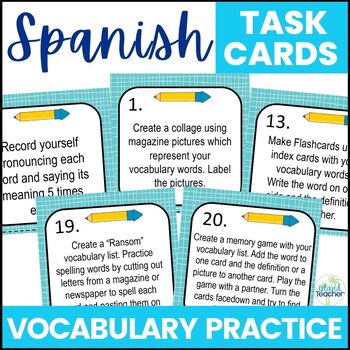
I love to leave general activities which can be adapted to whatever unit we are studying. This is one of the reasons why I created vocabulary task cards. These cards give students various task options
which can be used with any vocabulary unit. I give students a choice in which tasks to complete and require a specific amount to be handed in either at the end of the class period or when I return. This is a great way for students to still be productive in reviewing current class material without having a "wasted" day because of me being absent.

Answer from Caroline Marion I-Speak-Your-Language 
Many schools require sub plan folders ready to go on your desk when school begins. However, I have been caught without sub plans ready and have been able to e-mail in my lesson plans from home thanks to the internet.
In foreign language classes, we often face the problem of a sub who doesn’t speak the target language, making sub plans a difficult task. One idea is to have a great video or DVD that can be shown to the class. This should also include a set of questions over the video so students are accountable for something.
I have three products that can be used for sub plans.

This is a trivia game in English in which all answers are names of countries where Spanish is one of the official languages. It is my best seller.
Here is a reading in English about the Fiesta de San Fermin. Includes a trivia game and a mini-poster which can be cut up into a jigsaw puzzle. This product takes a little prep time to get it ready for the sub.
Here is a French reading, “Mon Oncle Jules” by Guy de Maupassant. It has been revised and simplified for French II students.


Answer from SpanishPlans
I try to have a few activities ready to go depending on where my students are in a unit. For example, if we are at the beginning of a unit, I will give students class time to practice their vocabulary with my Vocabulary Practice assignment where students can choose various activities worth varying points to remember their vocab. Kids love this activity and it keeps them busy in class and also helps tremendously with memorizing vocabulary.


Answer from Spanish Sundries 
For me, there are 3 components that a sub plan needs to have for things to go smoothly while I am gone;
1. It must not require the sub to speak Spanish (since they rarely do)
2. It must be tied to what we are learning or have learned (kids can spot busy work a mile away)
3. It must be VERY engaging...dare I say FUN so that those not so self-motivated actually want to do the assignment

These are some of my favorite activities to leave for emergency lesson plans as they meet all 3 criteria and then some:
Infographic Reading Activities
Spanish Logic Puzzles
Spanish Cartoon Listening Activities
With plans like these I don't have to feel guilty because I know my students learned something, but I also don't have to follow up on behavior issues when I get back.


I created a really fun PowerPoint that can be used for French and Spanish sub plans for levels II and up to AP. Students guess famous Americans and Hispanics based on 20 clues in the target language. The game reviews Spanish adjectives, professions, age, tener, ser, estar, etc., while learning interesting facts about famous people. These sub plans can be used for one day and then used again a few months later or can be used for three- five days of sub plans in a row.

There are descriptions and pictures of 27 people in total (15 Americans and 12 Hispanics). Some famous Hispanics are included, but not too many so that students can then research others and create their own clues. More advanced students can delve deeper into learning about other noteworthy Hispanics through a resume writing project. They will write resumes for the famous people, create an audio/visual, and then present to the class. The instructions and grading rubric for this project are included.

Check back for new posts with more sub activities! 


Thursday, August 21, 2014

Why study a foreign language

I like to start out my semester answering head on in a positive way the very question that many students negatively bring with them to the foreign language classroom.

Why do I have to study a foreign language anyway???


I hope that you not only find this interesting yourself, but that perhaps it may enable your students to see the benefits of what we already know to be true concerning knowledge of a second language!

Friday, August 1, 2014

First Week of School in the World Language Classroom

One of the activities I like to do the first week of school in my classroom is to ask my students, “Why are you studying a language?”  After they give honest answers such as:  “because I have to, so I can get into a good college, etc.”, I then ask them (in small groups) to come up with a list of why knowing another
language (Chinese, French, Spanish, Italian, German, Portuguese, Russian, etc.) could be useful in the future.  We write the answers from each group on the board so they can see the list.  I emphasize the global economy and the importance of knowing another language for your job, so you can communicate with employees and clients from other countries.  I talk about the numbers of people in the world who speak the language that we are studying:


Tuesday, July 29, 2014

Five Back to School Tips for the World Language Classroom

Five Back to School Tips for the World Language Classroom 

Okay so the summer has passed too quickly. You’re out of the house and on your way to school for the first day and as you are driving you’re wondering how you can motivate yourself to knock that list of things to do down to begin the school year off with a bang. Here are 5 Back to School Tips for teachers of World Languages.

1. Create a Poster to Remain in the Target LanguageStart the year off strong by remaining in the target language! Recent studies have shown that students of a second language acquire it at a faster rate if immersed in the language. To help keep yourself on target and your class as well create a poster with a flag from a country where the target language is spoken as well as a caption in the target language such as, “We speak ________ here.” On the reverse side create a poster with a flag of the native language of your students with the same expression in the native tongue and with an image of the flag. Place both posters in a page protector or laminate them front to back and pin the poster at the front of the classroom. Throughout the class period if you find that you must communicate something in the native language of your students be sure to walk to the front of the room and flip your poster to the appropriate flag/language. You will find that it is easier to remain in the target language and re-explain the information than it is to walk all the way to the front of the room and reverse the poster.

Wednesday, April 16, 2014

WL Products

Every other Wednesday, we plan to post great resources for World Language teachers. Sure, everyone loves a freebie (which is why we host Freebies on Mondays), however we also value the work that educators do. The prices you will find on products from TeachersPayTeachers.com are way better than those you would find from teacher catalogs, plus all the money goes to hard working teachers rather than big corporations.
These products take hours and hours to create and are created by teachers in the real world creating products for students. We value the hard work and dedication of these teachers.


Here are our Top 5 Foreign Language Resources for the Week of April 16, 2014:

Bouge Avec Les Chiffres by Madame H:
An active game in which French students race to create numbers as they are heard. The teacher will read a number aloud and students recreate them with number cards. There are 5 different games.


Foreign Language Vocabulary Task Cards 20 Activities by Island Teacher:
This packet contains 20 different task card activities for students to practice vocabulary. The packet is all in English, so it can be used with vocabulary in any foreign language classroom (Spanish, French, German, Italian, etc.). Great for differentiation and student choice.


Spanish Stories: Justo Castor - Superestrella Series & Activity Kit by Spanish Sundries:
This kit of original stories includes all 5 episodes of the "Justo Castor - Superestrella" (a story about Justin Bieber) series as well as 15 activities, 3 per episode. (60 pages total). Your students will enjoy examining the preterit and imperfect tenses, object pronouns, the future tense, gerunds AND learn loads of new vocabulary without even realizing they are working!


Spanish Rhyming Words las rimas for Dual Language by Open Wide the World:
This Spanish Rhyming Words - las rimas packet targets 24 words (12 word pairs) across 4 activities. Lots of ways to target this important phonological awareness & early reading component!
For Spanish Dual Language Immersion programs or Spanish as a foreign language teachers: no English on student pages!


World Language Review Games: 50 Games and Activities to Spice Up Your Classroom by The World Language Café:
These World Language review games, activities, and ideas will put the fun back into your classroom. Teach your students the target language while: designing T-shirts, enjoying authentic food at your own language cafe, playing classroom sports, singing songs, writing fairy tales, acting out movies, and much more. Your students will learn a ton, but won't even notice because they'll be having such a blast. This product includes over 50 games, activities, and ideas and over 30 pages of materials.


Monday, April 14, 2014

WL Freebies


Welcome to our first Monday of Free World Language Resources. We hope to be sure to share with you every week some wonderful resources to use in your foreign language class.... and best of all, they are FREE. Let's get to it!


Today's edition has 4 Spanish Resources, 2 French Resources, and 1 for any language class.


Spanish Lesson Plan Template
http://www.teacherspayteachers.com/Product/FREE-Editable-Spanish-Lesson-Plan-Template-Danielson-Framework-723602

Harry Potter Sub Plan


http://www.teacherspayteachers.com/Product/Cognates-Activity-754934


French Months of the Year Calendar Toppers
http://www.teacherspayteachers.com/Product/French-Months-of-the-Year-Calendar-Toppers-Freebie-460975


Passé Composé contre Imparfait Cooperative Learning Activity
http://www.teacherspayteachers.com/Product/Passe-Compose-contre-Imparfait-Cooperative-Learning-Activity-951002

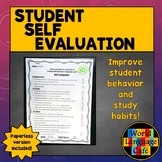
Student Self-Evaluation:
Pass these self-evaluation surveys out to students to help them understand what they can be doing better in class to improve their grades and their study habits.

Resources provided by: SpanishPlans, Elissa Garcia, Sra Dentlinger, Open Wide the World, The World Language Café, Spanish Sundries, and Madame H.

Check back next Monday for even more FREE resources.